
Non Surgical Biocompatible Periodontal Treatment...
THE BONNER METHOD
"before you pull the trigger, you need to know what the target is"
Do you know someone...
...who has bad breath?
...who has sensitive teeth and receding gums?
...who has difficulty maintaining a clean mouth, with heavy plaque formation which rapidly regenerates after brushing, or an unpleasant taste, an awareness of the gums, which bleed easily; ulcerations; halitosis (pungently reminiscent of garlic), sore, dry or itchy eyes and a history of generalized malaise, fatigue and frequent headache. Protracted or repetetive 'Flu like' symptoms were often reported if the infection had been recently contracted?
Did you know that gum disease
Can be treated successfully?
How is gum disease treated?
Periodontal disease is an infection of the gums and supporting structures of the teeth caused by bacteria and parasites. Our bio-periodontal
care is designed to identify and to eliminate the cause of the infection first, then remove the consequent tartar. We also
identify and treat the local and systemic factors associated with the onset and progression of the periodontal disease.
“Microscopy is a clinical tool that can assist in observing plaque and biofilm samples from the gums. This may help identify features
consistent with microbial activity associated with periodontal disease.
Management of gum disease typically involves professional cleaning, improved oral hygiene, and, where clinically indicated, the use of antimicrobial or other therapeutic measures. Treatment aims to reduce bacterial load and support gum health.
Periodontal disease varies between individuals, and treatment outcomes depend on multiple factors including oral hygiene practices, general health, and individual response to care.”
Once the infection has been eliminated, tartar build-up around the teeth can be properly removed and natural healing can occur. This disease is treated just like any other, by eliminating contamination factors.
Consequences of the disease
The infection progressively establishes itself in the gums, causing them to recede and bleed, leading to loosening and finally to loss of teeth. Not to mention the Oral-Systemic risk.... below..
Benefits of treatment
This disease can be treated by removing the flora containing pathogen microbes. Bad breath disappears, gum bleeding stops and healing can continue until the fissure has closed up around the teeth, and you can reduce your risk to many systemic illnesses.
The conventional approach
The usual dental hygiene and scaling methods help to eliminate tartar that forms around the teeth. However, bacteria and parasites are still present and continue to deteriorate the cavity around your teeth. In most cases, conventional treatments stabilize and slow the progress of the disease. Corrective surgery is often necessary but the return of the disease is in most cases inevitable. The Cause is not adressed.
Your Health Our Concern
Medical studies suggest there is a link between gum infections or dental infection and cardio-vascular disease, stroke, diabetes, Arthritis and infertility, premature births and low birth weight and a host of other conditions would be linked to oral health and that we would become integral in the "holistic" management of these diseases.
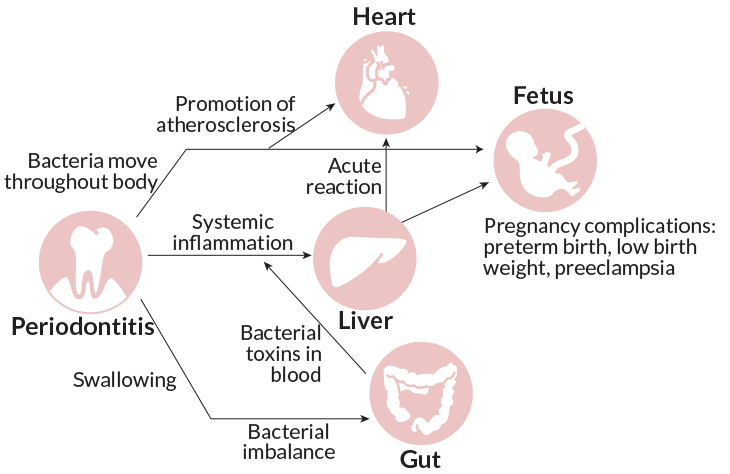
As time goes by, the list grows and when last looked at periodontal disease, as is true for other hidden infection, had been implicated or
associated with the following conditions – listed alphabetically:
|
Alzheimer’s disease |
Fever |
Myocardial infarction |
Anaemia |
Fibromyalgia |
Obesity |
Atherosclerosis |
Gastro-oesophageal reflux disease |
Obstructive sleep apnoea |
Autoimmune disease |
Hypertension |
Osteoporosis |
Cancer |
Infertility |
Pneumonia |
Chronic obstructive pulmonary disease |
Inflammatory bowel disease |
Polycystic ovaries |
Colon cancer |
Intellectual function reduced |
Pre-eclampsia |
Crohn’s disease |
Leukaemia |
Premature birth |
Death |
Low birth weight baby's |
Psoriasis |
Dementia |
Lung cancer |
Renal disease |
Diabetes |
Lupus |
Rheumatoid arthritis |
Dry mouth |
Metabolic syndrome |
Stroke |
Endometriosis |
Miscarriage |
Stomach ulcers |
Erectile dysfunction |
Mouth cancer |
|
Fatigue |
Multiple sclerosis |
Now that’s a list!
Whether all of these ‘associations’ are real or not, only time will tell, but certainly evidence is revealing they may be causal
in many conditions....“For people with the medical conditions listed above, it may be appropriate to discuss oral health and possible gum
infection with their dentist or medical practitioner. Assessment and treatment decisions should always be individualised.”
spirochetal-infections-and…
OSCD.pdf
Periodontal Disease and C-Reactive Protein (CRP)
Periodontal (gum) disease is an infection of the tissues that hold your teeth in place. .
Signs and symptoms of periodontitis can include:
- Swollen or puffy gums
- Bright red, dusky red or purplish gums
- Gums that feel tender when touched
- Gums that bleed easily
- Pink-tinged toothbrush after brushing
- Spitting out blood when brushing or flossing your teeth
- Bad breath
- Pus between your teeth and gums
- Loose teeth or loss of teeth
- Painful chewing
- New spaces developing between your teeth
- Gums that pull away from your teeth (recede), making your teeth look longer than normal
- A change in the way your teeth fit together when you bite
Relationship between periodontitis and C-Reactive Protein
There are many studies showing an increase in CRP and periodontitis.
C-reactive protein (CRP) elevation is a part of the acute phase response to acute and chronic inflammation. Many clinical studies have shown that serum CRP levels were elevated in patients with chronic periodontitis. CRP levels increase to hundreds of μg/ml within hours following infection.
CRP and Increased Risk For Heart Disease (CVD) and Diabetes
In the last decades, several lines of evidence have supported the existence of a relationship between periodontitis and systemic health.
For instance, periodontitis acts within the same chronic inflammatory model seen in cardiovascular disease (CVD), or other disorders, such as diabetes.
It is now evident that cardiac disorders are worsened by periodontitis, both experimentally and in humans. For all these reasons, it is very plausible that preventing periodontitis has an impact on the onset or progression of CVD and diabetes.
It is recommended to be checked for periodontitis in the event you have an elevated CRP.
Summary
In the event you have an elevated C-Reactive Protein, we recommend being evaluated for periodontal (gum) disease using The Bonner Method and ruling out failed root canal treated teath or areas in the jaw bone in old extraction sites for hidden infection - which maybe called a cavitation or NICO lesion.
Treatment: Steps to Success -- Click
here